
What Is Stock Market Health? A Practical Guide for Traders
Most traders spend a lot of time looking for setups.
They scan for breakouts, pullbacks, momentum, relative strength, oversold bounces, failed breakdowns, and whatever else fits their strategy. That work matters. A trader still needs a defined setup, a plan, and risk management.
But there is a question that should come before the setup:
Is this the kind of market where that setup deserves my capital?
That is the practical purpose of studying stock market health.
Market health is not about predicting every market move. It is not a magic indicator, and it will not remove uncertainty from trading. It is a way to judge the quality of the market environment before deciding how aggressively to trade.
The same stock setup can behave very differently in different environments. A breakout in a broad, constructive market with strong leadership and healthy participation has a different backdrop than a breakout in a narrow, choppy market where most stocks are failing beneath the surface.
That does not mean the first trade will always work or the second will always fail. Markets are never that clean. But context matters.
At Trade Risk, this is why we separate market context from individual trade signals. Market Navigator helps organize the broad environment: Market State, internals, sector leadership, industry leadership, and MAG 7 leadership. Quant Rockets focuses on individual swing trading opportunities. Those two pieces work together because a good individual stock signal is more useful when the broader market is supportive enough to act on it.
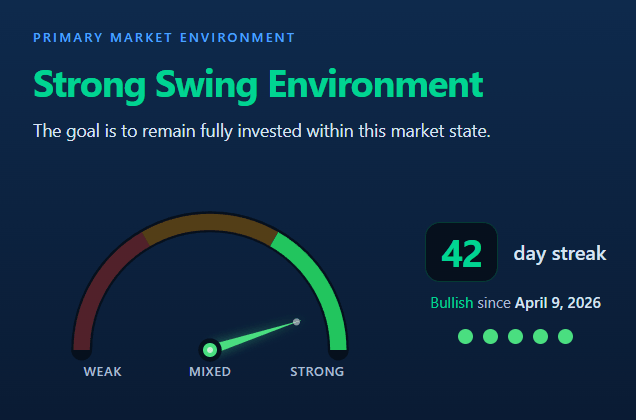
Market Navigator starts with the broad question first: what is the current health of the market?
This article will walk through what stock market health means, the main components traders can monitor, and how to turn that information into a practical daily process.
What Is Stock Market Health?
Stock market health refers to the quality of the overall market environment based on trend, participation, leadership, volatility, risk appetite, and follow-through.
A healthy market usually has several things working together:
- major indexes are in constructive trends
- many stocks are participating, not just a few large names
- market breadth and internals confirm price action
- strong sectors, industries, and leading stocks are emerging
- volatility is manageable
- breakouts and momentum setups are following through
An unhealthy market often shows the opposite:
- indexes are trending lower or chopping sideways
- participation is narrow
- rallies are driven by a small number of stocks
- market breadth diverges from index price
- volatility expands in a disruptive way
- breakouts fail quickly
- defensive areas lead while risk-taking gets punished
The key point is that market health is broader than whether the S&P 500 finished green or red on a given day.
An index can rise while the average stock struggles. A handful of mega-cap stocks can pull the major averages higher while breadth weakens underneath. A market can look calm at the index level but still offer poor conditions for active stock picking.
This is why traders need to look under the hood.
Stock market health is a context framework. It helps answer questions like:
- Is the market rewarding risk right now?
- Are more stocks joining the move or fewer?
- Are leading sectors and industries expanding?
- Are momentum stocks following through?
- Are breakouts working or failing?
- Should I be pressing, participating selectively, or standing aside?
None of these questions guarantee the outcome of a trade. They help define the backdrop.
That distinction matters. Market health should not replace a trade plan. It should help determine how much opportunity the current environment is actually offering.
Why Market Health Matters for Active Traders
Active traders live and die by follow-through.
It is not enough to find a stock that looks good for one bar, one session, or one scan result. A setup needs enough follow-through to make the trade worth the risk. That follow-through is easier to find when the broader market is constructive.
Think about a simple breakout setup.
In a strong market, more traders are willing to take risk. More stocks are advancing. More sectors are participating. Leadership is easier to identify. Breakouts have a better chance of attracting additional buyers after the initial move.
In a weak or mixed market, the same breakout may still appear on a chart, but the conditions around it are different. Buyers may be less willing to chase. Leadership may be narrow. Volatility may be higher. Failed moves may be more common. The setup may technically be valid, but the environment may be lower quality.
This is one of the reasons traders can become frustrated when a strategy works well during one stretch and then suddenly starts producing poor results. The setup did not necessarily change. The market around it did.
That is the heart of adapting to dynamic markets.
The goal is not to constantly change strategies or chase whatever worked yesterday. The goal is to understand when your strategy has a better or worse backdrop.
For swing traders, market health can influence:
- how many trades to take
- how aggressively to size positions
- how selective to be with entries
- whether to favor breakouts, pullbacks, or cash
- how much confirmation to require
- whether failed moves are becoming more common
- when to preserve mental and financial capital
This is where market context becomes practical.
If conditions are strong, a trader may be more willing to press the best setups within their risk limits. If conditions are mixed, the same trader may still participate but demand cleaner leadership and stronger confirmation. If conditions are weak, the best trade may be to reduce activity and stop forcing marginal opportunities. This is also where adapting trade frequency to market volatility becomes part of the process.
That is not defensive thinking. It is adaptive thinking.
The market does not offer the same quality of opportunity every day. A repeatable read on market health helps traders avoid treating every day like it deserves the same level of aggression.
The Main Components of Stock Market Health
Stock market health is not one number.
It is a collection of evidence. Some of that evidence comes from price. Some comes from breadth. Some comes from leadership. Some comes from how cleanly trades are following through.
The goal is not to find a single perfect indicator. The goal is to build a weight-of-the-evidence view of the current market environment.
That fits with the broader idea of using a rules-based trading framework instead of making every decision from scratch.
Here are the major pieces worth watching.
Trend
The first question is simple: what are the major indexes doing?
Are the S&P 500, Nasdaq, Russell 2000, and other important benchmarks trending higher, trending lower, or moving sideways? Are they above or below key moving averages? Are pullbacks being bought, or are rallies being sold?
Trend is not everything, but it is the starting point. A market making higher highs and higher lows sends a different message than a market repeatedly failing at resistance.
Breadth and participation
Breadth asks whether many stocks are participating in the move.
This matters because index performance can hide a lot. A small number of large stocks can lift a market-cap weighted index even while the average stock struggles. That may still create headline strength, but it is not the same as broad participation.
When breadth is healthy, more stocks are advancing, more groups are participating, and more setups have a chance to follow through.
When breadth is weak, the market may look better at the index level than it feels for active stock pickers.
Market internals
Market internals are the under-the-hood measures that help quantify participation.
Common examples include:
- advance-decline data
- new highs and new lows
- the percentage of stocks above key moving averages
- the McClellan Oscillator
- cumulative breadth measures
These tools are useful because they help confirm or challenge what price is showing. If the indexes are moving higher and internals are improving, that is a healthier message. If the indexes are rising while internals deteriorate, that divergence deserves attention.
Leadership
Healthy markets usually have leadership.
That leadership can show up in sectors, industries, themes, or individual stocks. For swing traders, this matters because the best opportunities often come from areas where buyers are already showing consistent demand.
Leadership also helps separate broad strength from narrow strength.
If the market is rising because many sectors and industries are participating, that is one type of environment. If the market is rising because a few mega-cap names are doing all the work, that is a different environment.
Neither condition guarantees what happens next, but they should lead to different levels of confidence.
Volatility
Volatility tells us how stable or unstable the market environment is.
Higher volatility is not automatically bearish. Some of the best opportunities appear after volatility expands and then starts to settle. But volatile, whippy conditions can make follow-through harder. They can increase failed breakouts, wider stops, and emotional decision-making.
The important question is whether volatility is helping create opportunity or simply adding noise.
Risk appetite
Risk appetite asks what traders are rewarding.
Are growth stocks working? Are momentum names following through? Are cyclicals and economically sensitive groups attracting buyers? Or is leadership concentrated in defensive sectors, cash-like instruments, and lower-volatility areas?
Risk appetite helps traders understand whether the market is encouraging offense, caution, or something in between.
Follow-through
Follow-through may be the most practical test for active traders.
Are breakouts holding? Are pullbacks bouncing? Are strong stocks extending after clean setups? Are earnings gaps being rewarded or sold? Are failed moves becoming common?
This is where the market leaves clues in real time.
If good setups keep failing, that is information. If leadership keeps expanding and trades keep following through, that is information too.
Market Breadth and Internals: Looking Under the Hood
Market breadth is one of the most useful ways to evaluate stock market health because it looks beyond the index headline.
The S&P 500 can be positive on the day, but that does not tell you whether the average stock is participating. The Nasdaq can make a new high, but that does not tell you whether strength is broad or concentrated in a few mega-cap leaders.
Breadth helps answer that question.
At a basic level, breadth measures how many stocks are participating in a move. Are more stocks advancing than declining? Are more stocks making new highs or new lows? Are more stocks above their moving averages or below them?
That information matters because a healthy advance is usually supported by expanding participation. More stocks are working. More groups are confirming the move. More traders are finding opportunities outside of a tiny corner of the market.
Weak breadth does not mean the market must immediately fall apart. Markets can stay narrow longer than traders expect. But weak breadth does mean the surface-level index signal may be less reliable than it looks.
This is especially important for swing traders.
If you trade individual stocks, your experience may not match the index. The S&P 500 can look fine while your scans get thinner, your breakouts fail faster, and fewer stocks meet your criteria. That disconnect is often a breadth problem.
Market internals help make this more concrete.
Some common internal measures include:
- advance-decline line
- McClellan Oscillator
- net new 52-week highs and lows
- cumulative advance-decline line
- percentage of stocks above moving averages
Each indicator has its own calculation and use case, but the purpose is similar: measure what is happening beneath the surface.
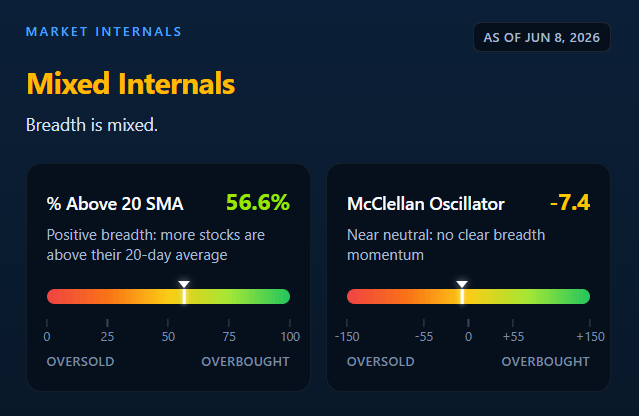
Market internals help show whether index price action is being confirmed by broader participation beneath the surface.
One of the most useful behaviors to watch is divergence.
If indexes are making higher highs but breadth is not confirming, the rally may be narrowing. If price is pulling back but breadth remains resilient, the market may be healthier than the headline decline suggests.
Breadth is not perfect. No internal indicator should be treated as a standalone trading system. But breadth gives traders a better read on the quality of the move.
For a deeper dive into specific breadth indicators, our article on how market internals can improve your trading walks through advance-decline data, the McClellan Oscillator, new highs and lows, and other useful measures.
Leadership: Are the Right Stocks and Groups Participating?
Breadth tells us how many stocks are participating. Leadership tells us which stocks and groups are driving the move.
Both matter.
A healthy market usually has visible leadership. Strong sectors start to separate. Industries show relative strength. Leading stocks make progress and hold gains. Traders can identify where demand is strongest.
This is not just an academic exercise. Leadership affects trade selection.
If the strongest stocks are concentrated in a few narrow areas, the opportunity set is different than if strength is spreading across multiple groups. If defensive sectors are leading while growth and momentum names are struggling, that says something about risk appetite. If industries tied to expansion are improving, that says something else.
For active traders, sector and industry leadership can help answer:
- Where is money flowing?
- Which groups are attracting persistent demand?
- Are leading stocks breaking out and holding gains?
- Is leadership broadening or narrowing?
- Are defensive groups outperforming risk-on groups?
This connects directly to the search for leading stocks, because the best individual names often come from areas where leadership is already visible.
Market Navigator is built around this idea. It does not just look at the index level. It also tracks sectors, industries, MAG 7 leadership, internals, and the overall Market State.
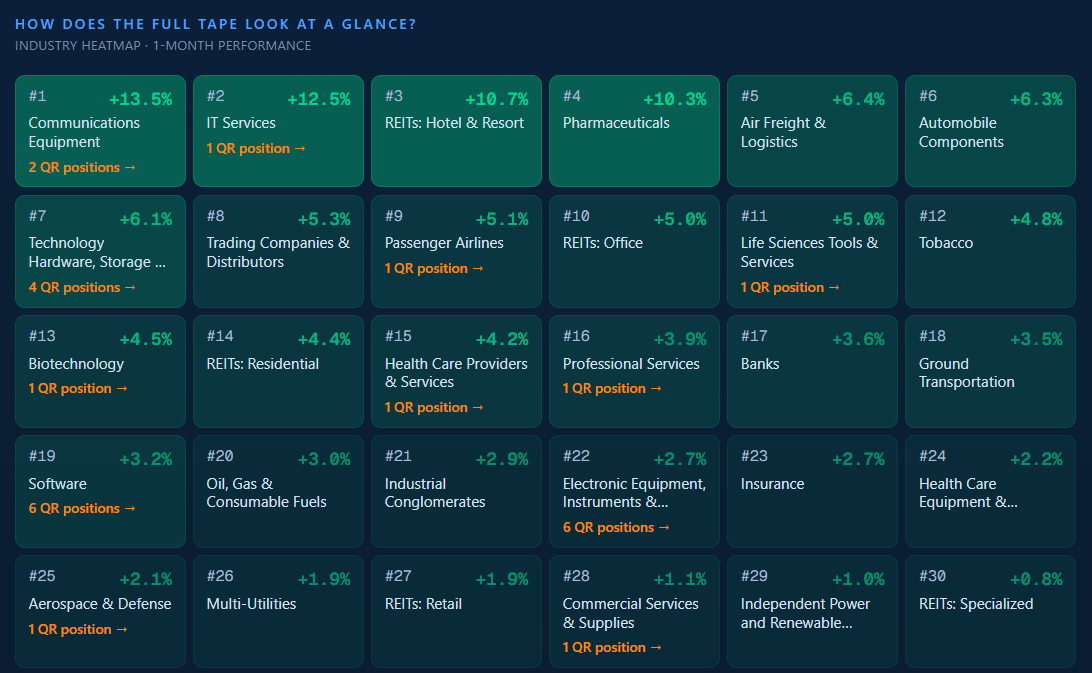
Industry leadership helps identify where participation is strongest and whether opportunity is broadening or narrowing.
That matters because leadership can explain the difference between a market that is broadly healthy and a market that is being held together by a small number of names.
Mega-cap leadership deserves its own attention because of how much influence the largest stocks can have on the indexes. If MAG 7 names are strong while the average stock is weak, the index may look healthier than the broader opportunity set. If mega-cap leadership is strong and breadth is improving too, the message is more constructive.
Again, the point is not to create a perfect forecast. It is to understand the environment you are trading in.
Volatility, Risk Appetite, and Follow-Through
Market health is also visible in the character of price action.
Some markets are orderly. Pullbacks are contained. Breakouts hold. Leaders act well. Volatility is present, but not disruptive.
Other markets are unstable. Rallies fail quickly. Breakouts reverse. Gaps fade. Stops get hit more often. Traders feel like they are doing everything right, but the market keeps changing its mind.
That difference matters.
Volatility can create opportunity, but it can also create noise. The question is not simply whether volatility is high or low. The question is whether the current volatility is producing clean opportunity or unreliable movement.
Risk appetite helps fill in the picture.
When traders are willing to take risk, you often see stronger behavior in growth stocks, momentum names, cyclical sectors, and higher-beta areas. When traders are avoiding risk, leadership often shifts toward defensive groups, cash-like behavior, or lower-volatility areas.
Follow-through is the practical test.
Are traders being rewarded for taking risk?
If breakouts keep working, leadership expands, and pullbacks are bought, that is constructive. If the market keeps punishing risk-taking, the trader should listen.
This does not mean a trader should become bearish every time a few trades fail. Individual trades fail all the time. But when failed moves become a pattern, it is often a sign that the market environment has changed.
Strong, Mixed, and Weak Market Conditions
One way to make market health useful is to classify the environment.
At Trade Risk, we think in terms of Strong, Mixed, and Weak conditions.
This does not need to be complicated.
Strong market conditions
Strong conditions usually include:
- constructive index trends
- broad participation
- improving internals
- expanding leadership
- manageable volatility
- healthy risk appetite
- reliable follow-through from quality setups
In this environment, traders may be more willing to press their best ideas, take more qualified setups, and give strong trades room to work.
Strong does not mean risk disappears. It means the evidence is more supportive.
Mixed market conditions
Mixed conditions are more conflicted.
Some evidence may be positive, but not enough to fully trust the environment. Indexes may be holding up while breadth weakens. Leadership may be narrow. Volatility may be choppy. Some setups may work while others fail quickly.
In this environment, traders can still participate, but selectivity matters more.
Mixed conditions often call for:
- fewer trades
- cleaner setups
- stronger leadership requirements
- more patience
- less tolerance for marginal ideas
Weak market conditions
Weak conditions usually include:
- poor index trends
- deteriorating breadth
- weak or defensive leadership
- expanding volatility
- failed rallies
- poor follow-through
- little reward for risk-taking
In this environment, the job is not to prove how active you can be. The job is to protect capital, protect focus, and wait for better conditions.
Cash is a position when the market is not offering enough edge.
This is where Market Navigator becomes useful as a daily context tool. It organizes the evidence into a repeatable Market State instead of forcing traders to rebuild the entire market read from scratch every day.
How Traders Can Use Market Health in a Daily Process
The value of market health is not in having an opinion. It is in making better trading decisions.
A simple daily process can look like this:
- Check the major indexes.<br>Are they trending, rangebound, extended, or breaking down?
- Check breadth and internals.<br>Is participation confirming the index move or diverging from it?
- Check new highs and new lows.<br>Are more stocks breaking out to new highs, or are new lows expanding?
- Check sector and industry leadership.<br>Where is demand strongest? Is leadership broadening or narrowing?
- Check major index drivers.<br>Are mega-cap leaders supporting the market, masking weakness, or dragging indexes lower?
- Check volatility and follow-through.<br>Are trades holding gains, or are setups failing quickly?
- Decide the trading posture.<br>Should you press, participate selectively, or stand down?
This last step is the point.
Market health should translate into behavior.
If conditions are strong, you may be more open to new exposure. If conditions are mixed, you may still trade but require better evidence. If conditions are weak, you may reduce activity and wait for the market to improve.
The goal is not to be right about every wiggle in the market. The goal is to avoid applying the same level of aggression to every environment.
How Trade Risk Uses This Process
This framework is not just theoretical for us.
It is how we think about the relationship between Market Navigator and Quant Rockets.
Market Navigator is the context layer. It is designed to organize the broad market environment: Market State, market internals, sector leadership, industry leadership, and MAG 7 leadership.
Quant Rockets is the swing-trading signal layer. It focuses on individual stocks and momentum opportunities.
Those two jobs are different, but they belong together.
Quant Rockets can identify stocks with attractive momentum characteristics, but a good-looking setup still needs context. If the market backdrop is strong, the trader may have more confidence pressing the best signals. If the backdrop is mixed, the trader may be more selective. If the backdrop is weak, the trader may decide that even good-looking setups do not deserve much capital. For traders newer to the style, this builds on the basics of getting started swing trading stocks but adds the market-context layer.
That is what we mean by using what we teach.
Market health is not a decorative concept. It is part of the decision-making process. It helps connect the broad environment to the individual trade.
This is also why visuals matter in an article like this. A screenshot of Market Navigator’s Market State, internals, sector leadership, industry leadership, or MAG 7 leadership can make the concept more concrete. A Quant Rockets example can show how the signal layer depends on the environment layer.
The point is not to say, go buy a product. The point is to show the workflow:
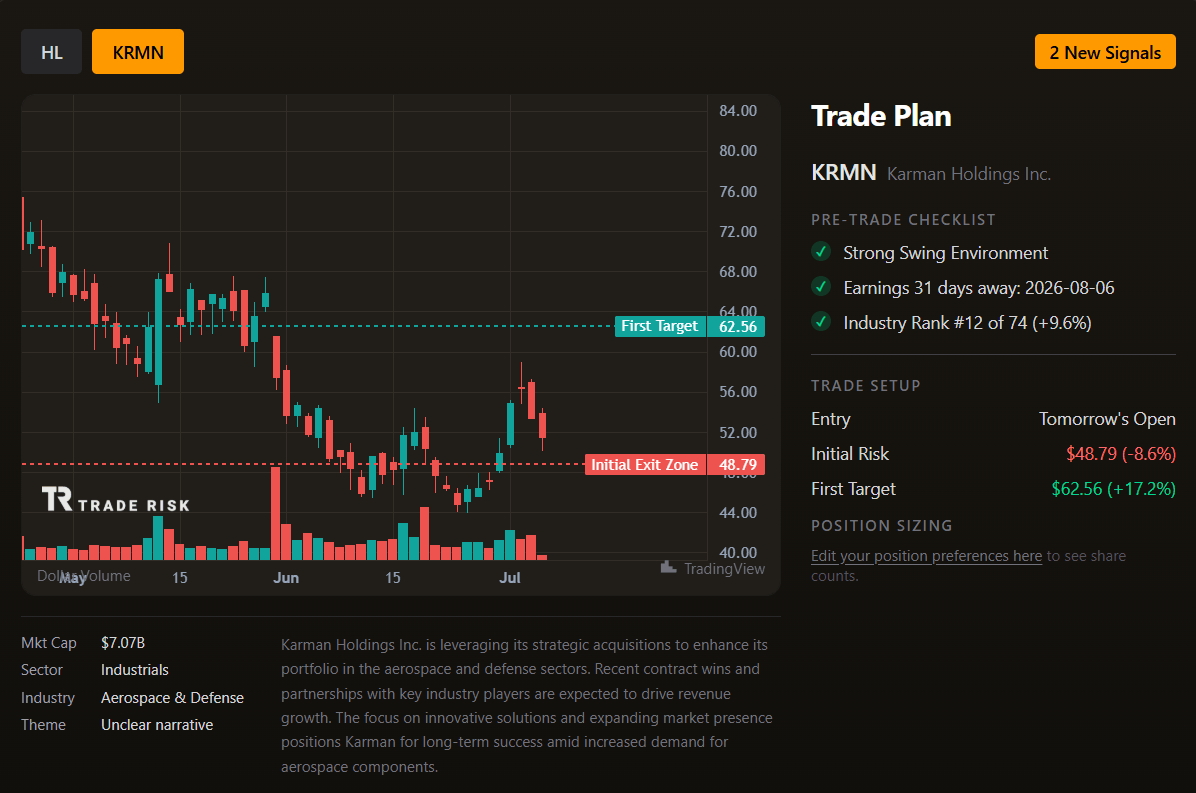
Market Navigator helps define the market backdrop, Quant Rockets identifies individual swing trading opportunities, and the final trade plan connects the signal to risk.
Market context first. Individual signals second. Risk decision third.
That process is useful whether a trader is using Trade Risk tools or building their own version of the same framework.
The Real Question: Does This Setup Deserve Capital?
Stock market health is about context.
It helps traders look beyond the index headline and ask whether the broader environment is actually supportive of risk-taking.
No market health framework will eliminate uncertainty. No breadth indicator, leadership screen, or Market State classification will make every trade work. That is not the goal.
The goal is to make better decisions before capital is at risk.
When the market is healthy, traders can look for ways to press their best opportunities. When conditions are mixed, they can become more selective. When conditions are weak, they can stop forcing trades and wait for a better backdrop.
For active traders, that shift matters.
The question is not only, Do I see a setup?
The better question is:
Is this the kind of market where that setup deserves my capital?
Enjoy what you read? Share it below and be sure to tag @thetraderisk.
Posted in Article, Stock Market Internals, Trading Education, Trading Strategy
Tagged with Market Breadth, Market Environment, Market Internals, Market Navigator, Momentum Trading, Quant Rockets, Risk Management, Rules-Based Trading, Sector Leadership, Stock Market Health, Swing Trading, Trading Conditions
